
Overview
Architected, deployed, and maintained an enterprise-grade on-premise infrastructure, evolving from legacy virtualization to a sophisticated, fully automated Cloud-Native platform. Spearheaded the migration to Kubernetes (OKD/OpenShift), implementing GitOps practices, Zero Trust security, and full-stack observability.
Cloud-Native Infrastructure & Orchestration
- Kubernetes Migration: Led the strategic migration of workloads from Docker Compose to K3s, and ultimately to OKD (OpenShift), enabling enterprise-level orchestration.
- GitOps Implementation: Established a declarative delivery model using ArgoCD for continuous deployment and Tekton for CI pipelines, integrating with self-hosted Gitea and Quay registries.
- Cluster Management: Managed full lifecycle of bare-metal clusters (IPI/SNO), including automated provisioning, scaling, and seamless upgrades (up to OKD 4.21).
Storage & Virtualization
- Software-Defined Storage: Deployed and tuned Ceph/ODF (Rook) and MinIO for high-performance block and object storage.
- Hybrid Workloads: Leveraged KubeVirt to orchestrate legacy Virtual Machines alongside containerized microservices.
- Historical Evolution: Progressed through VMware Workstation, KVM/QEMU, and FreeNAS/TrueNAS before converging on hyper-converged infrastructure.
Networking & Security
- Advanced Networking: Implemented OVN-K8s, MetalLB, Gateway API, and Istio Service Mesh for complex traffic management and ingress control.
- Zero Trust Security: Enforced security policies using Kyverno, Stackrox, and NetworkPolicies. Managed identity and access via Zitadel (OIDC) and Vault.
- Edge Networking: Configured pfSense, UniFi, and Cloudflare DDNS for robust edge routing and connectivity.
Observability & Reliability
- Full-Stack Monitoring: Built comprehensive observability pipelines using Prometheus, Grafana, Loki, and VictoriaMetrics for metrics and logs.
- Performance Tuning: Implemented Network Observability, Power Monitoring, and Dragonfly for efficient image distribution.
- Resiliency: Designed backup and disaster recovery strategies using Velero and External Secrets.
Technology Stack
- Platforms: OKD (OpenShift), Kubernetes, K3s, Docker, MicroShift.
- IaC & Config: Ansible, Terraform, Helm, Kustomize.
- CI/CD: ArgoCD, Tekton, GitLab CI, GitHub Actions.
- Storage: Ceph, Rook, MinIO, Longhorn, TrueNAS (ZFS).
- Networking: Istio, Traefik, MetalLB, OVN-K8s, pfSense.
- Observability: Prometheus, Grafana, Loki, VictoriaMetrics, Stackrox.
- Languages: Python, Bash, Go.
Screenshots
HomeLab Screenshots.
Click on an Image to Expand it
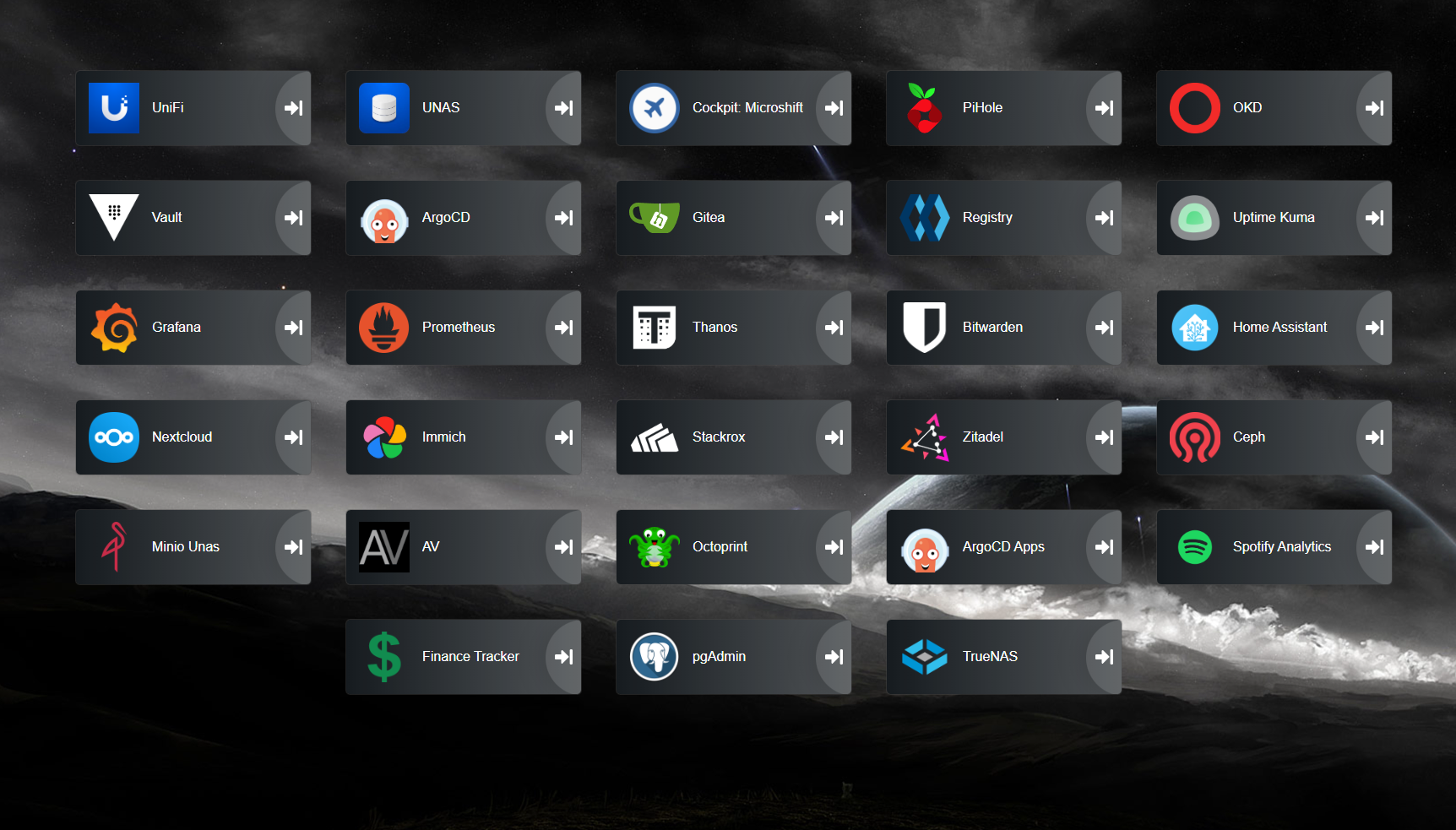
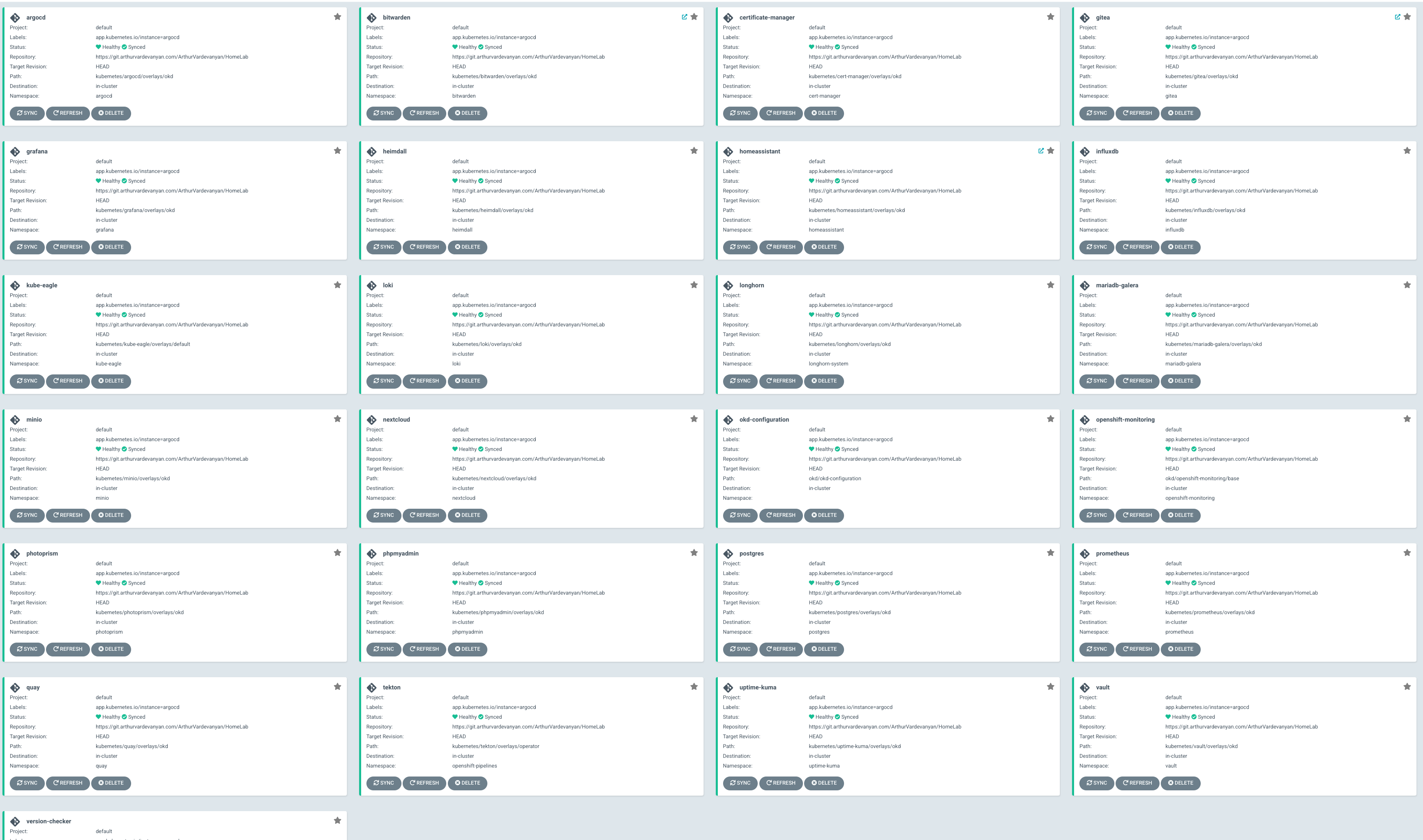
Timeline / Process
For more detailed and up to date information check: CHANGELOG
-
Windows Server
Early 2016
- Focus: Enterprise Windows environment simulation.
- OS: Windows Server 2012 R2.
- Key Tech: Active Directory Domain Services, IIS, DNS, DHCP.
- Hardware: Initial dedicated server hardware acquisition.
-
VMware Workstation
Late 2016
- Focus: Desktop Virtualization and Linux exploration.
- Platform: VMware Workstation Pro 12 running on Windows.
- Experiments: Early Linux adoption (Ubuntu, Kali, Mint) running as VMs. OpenVPN (August 2016) running in a custom VM.
- Key Tech: XRDP for remote access, Virtual Network Editor.
-
The Rise of Self-Hosting
2017 - 2018
- Infrastructure: Introduction of FreeNAS for storage and pfSense for routing (August 2017). OpenVPN on pfSense (February 2017).
- Workloads: Nextcloud (v11) inception, Bind9 DNS.
- OS: Shift towards Ubuntu Server 16.04 as the primary host.
- Desktop: Deep dive into Ubuntu Desktop and ZFS on Linux.
- Apps: Nextcloud, Spotify on Linux, and Minecraft Servers.
-
Advanced Storage & Networking
2019
- Storage: Heavy focus on FreeNAS tuning (ZFS RAID levels, SSD Caching, Scrubs).
- Networking: Virtualizing pfSense, VLAN segmentation
- Key Tech: iSCSI for VM storage, NFS for file sharing.
- Experiments: Active Directory on Linux (Samba 4).
-
Hardware & Passthrough
2020
- Hardware: Raspberry Pi 4 for OctoPrint.
- OS: Distro hopping (Pop!_OS, Manjaro, Fedora).
- Migrations: P2V (Physical to Virtual) migrations of legacy Windows machines.
- Networking: WireGuard (April 2020) exploration.
-
The Docker Era
Early 2021 - August 2021
- Early 2021: Researching Docker, Podman, and container networking.
- June 15, 2021: Initial Commit establishing the Docker environment.
- June 18, 2021: Implementation of `macvlan` network routes, moving away from simple bridge networking.
- June 25, 2021: Cockpit configuration for server management.
- July 31, 2021: Introduction of Portainer for UI-based container management.
- Workloads: Nextcloud, MariaDB, HomeAssistant, Spotify Analytics, Pi-Hole, GitLab (Code Hosting).
-
Kubernetes Migration
August 2021 - December 2021
- August 22, 2021: First Kubernetes-related commits appear.
- September 8, 2021: "Kubernetes Move" - The official migration point from Docker Compose.
- November 28, 2021: Full conversion to Longhorn PV/PVCs, enabling stateful workload mobility.
- December 10, 2021: Bitwarden (Vaultwarden) inception for password management.
- Late 2021: Introduction of Kubernetes Dashboard, Metrics Server, and Kube Eagle for cluster visibility.
- Workloads: Prometheus/Grafana stack, Heimdall Dashboard, Bitwarden, Uptime Kuma, Cert-Manager, Hashicorp Vault.
-
The OKD Migration
Early 2022
- January 16, 2022: Upgrade of K3s to High Availability (HA) mode.
- February 6, 2022: pfSense physical inception, replacing the default ISP router.
- March 27, 2022: Automated Sandbox OKD Installation.
- March 28, 2022: Inception of ArgoCD, establishing the GitOps workflow.
- May 21, 2022: Gitea inception, replacing GitLab.
- May 21, 2022: Tekton pipelines implemented.
- May 22, 2022: MinIO, Quay, and Postgres inception.
-
Security & Stability
Late 2022
- October 20, 2022: Stackrox inception for continuous security monitoring.
- November 3, 2022: TrueNAS inception serving as an S3 backup target.
- November 25, 2022: Smoke Tests implementation for cluster validation.
-
Identity & Observability
Early 2023
- January 11, 2023: Network Observability inception.
- April 27, 2023: Keep Alive service for connection persistence.
- May 1, 2023: Zitadel inception, replacing Keycloak.
-
Developer Experience & Serverless
Late 2023
- October 29, 2023: Eclipse Che inception.
- October 30, 2023: Kyverno and Image Puller inception.
- November 21, 2023: Knative Serverless inception.
-
Hybrid Networking & Storage
Early 2024
- January 31, 2024: Kube-VIP inception.
- February 9, 2024: UniFi Network Application inception, marking the shift from pfSense to UniFi hardware.
- February 2024: External Secrets Operator and MongoDB Operator.
- March 7, 2024: GitHub Runners for self-hosted CI/CD capacity.
- April 5, 2024: Strategic shift to Ceph.
- May 27, 2024: Velero inception for disaster recovery.
-
Virtualization & Edge
Late 2024
- June 28, 2024: KubeVirt inception.
- July 4, 2024: NMState for declarative network configuration.
- July 13, 2024: Nested Virtualization enabled in KubeVirt.
- September 8, 2024: MicroShift inception.
- September 11, 2024: External DNS and OLM (Operator Lifecycle Manager) enhancements.
- October 10, 2024: AWX inception.
- Late 2024: Blackbox Exporter, Observability Operator, and NTP standardization.
- December 2024: UniFi WireGuard implementation.
- December 13, 2024: Netbox inception.
-
The Bare Metal Rebuild
Early 2025
- Early 2025: Major Rebuild - Transition to OKD Baremetal IPI with Agent-based Installer.
- March 7, 2025: Single Node OpenShift (SNO) deployment with LVM storage serving as a critical stop-gap during the bare-metal migration.
- March 31, 2025: Deployment Validation operator.
- April 1, 2025: OpenShift Power Monitoring.
- April 5, 2025: Automated Nested OKD/OpenShift support in KubeVirt.
- April 16, 2025: KFCA (Kubernetes Full Cluster Audit).
-
Hardware Acceleration & Observability 2.0
Late 2025
- July 22, 2025: Immich inception.
- August 9, 2025: Kube Descheduler for workload optimization.
- August 30, 2025: UNAS inception for storage workloads.
- October 3, 2025: Nextcloud Architecture Rebuild - Migration to FPM/S3 architecture.
- November 8, 2025: GPU Integration (#281) and Node Feature Discovery.
- November 15, 2025: OpenShift Service Mesh.
- November 18, 2025: Adoption of VictoriaMetrics.
- Late 2025: BMC Shim for bare-metal autoscaling.
-
Platform Resilience & Networking 2.0
Early 2026
- December 11, 2025: Renovate inception for automated dependency management.
- December 20, 2025: IaC Linting with Checkov, ansible-lint, and yamllint.
- January 20, 2026: OKD upgrade to 4.21.0-okd-scos.1 (GA).
- January 23, 2026: WASM inception and External Gateway with Cloudflare IP whitelisting.
- January 23, 2026: BGP for Gateway API load balancing.
- January 31, 2026: ArgoCD Shallow Clone for faster syncs.
- February 12, 2026: Vertical Pod Autoscaler (VPA) inception.
- February 13, 2026: OKD upgrade to 4.22.
- February 15, 2026: Technitium DNS inception, replacing Pi-hole. Clustering and VLAN integration.
- February 15, 2026: External DNS UniFi inception for automatic DNS record management.
- February 23, 2026: MetalLB revived, Coraza WAF prep.
- February 25, 2026: Coraza WAF inception.
- March 4, 2026: Wire-Tap inception for network traffic inspection.
- March 6, 2026: CloudNative-PG migration from Crunchy Postgres.
- March 12, 2026: Docker Registry inception, Renovate switch to GitHub App.